In my latest article I discussed the importance of JRuby as a means of introducing Ruby to the Enterprise world. Most of the companies that belong to this ecosystem are Java based, but we cannot forget that a sizable portion of them are Microsoft-centric. Within these companies, Ruby will be far more welcome if a .NET implementation is available. The answer to this need is sufficiently fulfilled by IronRuby (version 0.9 was just released).
IronRuby has been progressing fast lately. First came support for Rails and then, with this release, a great deal of effort has been placed on improving performance. In the past, IronRuby was all but fine-tuned. In fact, it was several times slower than Ruby MRI, as the team worked on improving compatibility with Ruby 1.8 and mostly ignored performance.
In this article I’m going to provide some performance results for IronRuby 0.9 on Windows, which I’m sure will interest readers of this blog as well as of my book. Before revealing all the details, let’s start with the setup and a disclaimer. Please read through it carefully, because the old, trite comments about how “micro-benchmarks are useless” won’t be published. We’ve already been there, folks. Thank you all for your understanding.
Setup
- The benchmarks were run within a virtual machine with 2 GB of DDR3 RAM and a 2.66 GHz Intel Core 2 Duo processor. The operating system adopted was Windows XP SP3 (32 bit) with the .NET Framework 3.5 SP1 installed.
- Here I employed a large subset of the current Ruby Benchmark Suite project. The source code for all of the benchmarks is available within the repository.
- The best time out of five runs is reported for each benchmark. When the results report a Timeout, it means that more than 300 seconds were required for a single iteration and was therefore interrupted. Conversely, N/A means that a test that was compatible for the given implementation was not available (2 tests) or the setup on my machine was lacking the required libraries to execute it (1 test).
- I realize that there is a MinGW One-Click Installer effort that may improve the performance of Ruby on Windows. Here however, I used the regular One-Click Installer as it is the most common one (it’s been downloaded almost 3.5 million times so far). For Ruby 1.9 I used the binary provided by the download page on the official Ruby site.
Disclaimer
- An attempt has been made to improve the quality of the tests. Some of them may be more representative of realistic workloads, but most of them remain micro-benchmarks. They are indicative of how IronRuby compares to MRI (Ruby 1.8) and KRI (Ruby 1.9) performance-wise, but cannot be viewed as a guarantee of how this will actually affect your own programs.
- I didn’t calculate a RubySpec completeness score for IronRuby. That said, IronRuby 0.9 should be a fairly complete implementation of Ruby 1.8.
- There are lies, damned lies, and statistics.
Benchmark results
The table below shows the times for each benchmark, for IronRuby 0.9, Ruby 1.8.6 (2008-08-11 patchlevel 287) and Ruby 1.9.1p0 (2009-01-30 revision 21907):
| Benchmark File | # | Ruby 1.8.6 | IronRuby | Ruby 1.9.1 |
| macro-benchmarks/bm_gzip.rb | 100 | Timeout | IOError | N/A |
| macro-benchmarks/bm_hilbert_matrix.rb | 20 | 1.891 | 0.453 | 0.125 |
| macro-benchmarks/bm_hilbert_matrix.rb | 30 | 7.422 | 1.719 | 0.656 |
| macro-benchmarks/bm_hilbert_matrix.rb | 40 | 21.500 | 4.625 | 2.266 |
| macro-benchmarks/bm_hilbert_matrix.rb | 50 | 56.765 | 10.031 | 5.109 |
| macro-benchmarks/bm_hilbert_matrix.rb | 60 | 111.859 | 18.781 | 11.297 |
| macro-benchmarks/bm_norvig_spelling.rb | 50 | Timeout | 41.313 | 31.453 |
| macro-benchmarks/bm_sudoku.rb | 1 | 43.734 | Timeout | 6.313 |
| micro-benchmarks/bm_app_factorial.rb | 5000 | 1.328 | 0.063 | 0.266 |
| micro-benchmarks/bm_app_fib.rb | 30 | 6.156 | 0.594 | 0.813 |
| micro-benchmarks/bm_app_fib.rb | 35 | 74.125 | 6.922 | 9.344 |
| micro-benchmarks/bm_app_mandelbrot.rb | 1 | 11.953 | 6.922 | 0.641 |
| micro-benchmarks/bm_app_pentomino.rb | 1 | Timeout | 59.938 | 75.859 |
| micro-benchmarks/bm_app_strconcat.rb | 1.5M | 30.469 | 2.141 | 4.813 |
| micro-benchmarks/bm_app_tak.rb | 7 | 5.516 | 0.531 | 0.578 |
| micro-benchmarks/bm_app_tak.rb | 8 | 15.609 | 1.484 | 1.703 |
| micro-benchmarks/bm_app_tak.rb | 9 | 45.843 | 3.953 | 4.531 |
| micro-benchmarks/bm_app_tarai.rb | 3 | 19.985 | 1.844 | 2.156 |
| micro-benchmarks/bm_app_tarai.rb | 4 | 19.796 | 2.219 | 2.656 |
| micro-benchmarks/bm_app_tarai.rb | 5 | 24.235 | 2.688 | 3.063 |
| micro-benchmarks/bm_binary_trees.rb | 1 | Timeout | 53.078 | 37.375 |
| micro-benchmarks/bm_count_multithreaded.rb | 16 | 0.297 | 0.266 | 0.328 |
| micro-benchmarks/bm_count_shared_thread.rb | 16 | 0.250 | 0.188 | 0.203 |
| micro-benchmarks/bm_fannkuch.rb | 8 | 3.625 | 0.344 | 0.563 |
| micro-benchmarks/bm_fannkuch.rb | 10 | Timeout | 40.750 | 65.438 |
| micro-benchmarks/bm_fasta.rb | 1M | 192.937 | 23.703 | 35.234 |
| micro-benchmarks/bm_fractal.rb | 5 | 43.172 | 4.672 | 5.781 |
| micro-benchmarks/bm_gc_array.rb | 1 | 228.672 | 32.031 | 59.828 |
| micro-benchmarks/bm_gc_mb.rb | 500K | 8.109 | 1.109 | 0.469 |
| micro-benchmarks/bm_gc_mb.rb | 1M | 16.172 | 2.391 | 1.016 |
| micro-benchmarks/bm_gc_mb.rb | 3M | 44.953 | 6.906 | 2.938 |
| micro-benchmarks/bm_gc_string.rb | 1 | 47.937 | 25.250 | 11.938 |
| micro-benchmarks/bm_knucleotide.rb | 1 | 9.625 | 2.906 | 2.016 |
| micro-benchmarks/bm_lucas_lehmer.rb | 9689 | 122.672 | 18.125 | 36.250 |
| micro-benchmarks/bm_lucas_lehmer.rb | 9941 | 156.750 | 19.625 | 39.391 |
| micro-benchmarks/bm_lucas_lehmer.rb | 11213 | 179.915 | 28.844 | 61.063 |
| micro-benchmarks/bm_lucas_lehmer.rb | 19937 | Timeout | 159.078 | Timeout |
| micro-benchmarks/bm_mandelbrot.rb | 1 | Timeout | 65.781 | 81.766 |
| micro-benchmarks/bm_mbari_bogus1.rb | 1 | 0.031 | 40.406 | 8.781 |
| micro-benchmarks/bm_mbari_bogus2.rb | 1 | 0.156 | Timeout | N/A |
| micro-benchmarks/bm_mergesort_hongli.rb | 3000 | 25.282 | 3.531 | 6.031 |
| micro-benchmarks/bm_mergesort.rb | 1 | 24.735 | 3.906 | 3.219 |
| micro-benchmarks/bm_meteor_contest.rb | 1 | 147.704 | 19.713 | 19.781 |
| micro-benchmarks/bm_monte_carlo_pi.rb | 10M | 79.406 | 5.109 | 20.672 |
| micro-benchmarks/bm_nbody.rb | 100K | 37.625 | 8.281 | 10.938 |
| micro-benchmarks/bm_nsieve_bits.rb | 8 | 69.656 | 33.156 | 6.531 |
| micro-benchmarks/bm_nsieve.rb | 9 | 58.344 | 5.453 | N/A |
| micro-benchmarks/bm_partial_sums.rb | 2.5M | 93.391 | 10.797 | 26.422 |
| micro-benchmarks/bm_pathname.rb | 100 | Timeout | Timeout | Timeout |
| micro-benchmarks/bm_primes.rb | 3000 | 21.359 | 9.594 | 0.031 |
| micro-benchmarks/bm_primes.rb | 30K | Timeout | Timeout | 0.469 |
| micro-benchmarks/bm_primes.rb | 300K | Timeout | Timeout | 5.281 |
| micro-benchmarks/bm_primes.rb | 3M | Timeout | Timeout | 100.406 |
| micro-benchmarks/bm_quicksort.rb | 1 | 51.046 | 11.594 | 8.703 |
| micro-benchmarks/bm_regex_dna.rb | 20 | 181.172 | 21.188 | 11.938 |
| micro-benchmarks/bm_reverse_compliment.rb | 1 | 61.875 | 48.469 | 138.047 |
| micro-benchmarks/bm_so_ackermann.rb | 7 | 2.234 | 0.563 | 0.484 |
| micro-benchmarks/bm_so_ackermann.rb | 9 | 50.000 | 14.938 | 9.281 |
| micro-benchmarks/bm_so_array.rb | 9000 | 26.328 | 8.984 | 10.781 |
| micro-benchmarks/bm_so_count_words.rb | 100 | Timeout | 60.688 | 42.250 |
| micro-benchmarks/bm_so_exception.rb | 500K | 78.125 | Timeout | 32.672 |
| micro-benchmarks/bm_so_lists_small.rb | 1000 | 13.906 | 4.250 | 3.172 |
| micro-benchmarks/bm_so_lists.rb | 1000 | 64.531 | 22.266 | 16.797 |
| micro-benchmarks/bm_so_matrix.rb | 60 | 8.312 | 2.781 | 2.125 |
| micro-benchmarks/bm_so_object.rb | 500K | 16.375 | 5.313 | 1.672 |
| micro-benchmarks/bm_so_object.rb | 1M | 29.312 | 10.500 | 2.844 |
| micro-benchmarks/bm_so_object.rb | 1.5M | 43.312 | 16.000 | 4.281 |
| micro-benchmarks/bm_so_sieve.rb | 4000 | 241.922 | 37.859 | 35.688 |
| micro-benchmarks/bm_socket_transfer_1mb.rb | 10K | 13.266 | SocketError | 3.359 |
| micro-benchmarks/bm_spectral_norm.rb | 100 | 5.110 | 0.922 | 0.719 |
| micro-benchmarks/bm_sum_file.rb | 100 | Timeout | 20.406 | 23.797 |
| micro-benchmarks/bm_word_anagrams.rb | 1 | 70.828 | 30.188 | 8.125 |
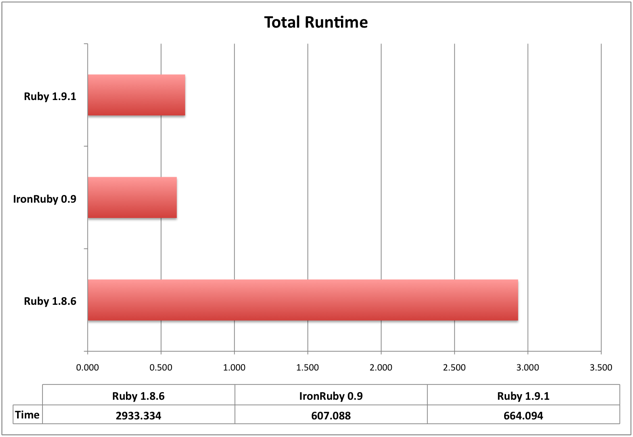
| TOTAL TIME | – | 2933.334 | 607.088 | 664.094 |
Red values are errors, timeouts, inapplicable tests and times that were worse than Ruby 1.8.6. Green, bold values are better times than what Ruby 1.8.6 delivered. A pale yellow background indicates the best time for a given benchmark. Total time is the runtime for the subset of benchmarks that were successfully executed by all three implementations (whose cardinality is 54).
The total runtime is summarized by the chart below:
And let’s compare each of the “macro-benchmarks” on an individual basis:

Conclusions
IronRuby went from being much slower than Ruby MRI to considerably faster across nearly all the tests. That’s major progress for sure, and the team behind the project deserves mad props for it.
One final warning before we get too excited here. IronRuby is not faster than Ruby 1.9.1 at this stage. Don’t let that first chart mislead you. While it’s faster in certain tests, it’s also slower is many others. Currently, it’s situated between Ruby 1.8.6 and Ruby 1.9.1, but much closer to the latter. The reason why this chart is misleading is that it doesn’t take into account any tests that timed out, and several of such timeouts were caused by IronRuby (more than those caused by Ruby 1.9.1). If you were to add, say, 300 seconds to the total, for each timeout for the two implementations, you’d quickly see that Ruby 1.9.1 still has the edge. The second chart that compares macro-benchmarks does a better job at realistically showing how IronRuby sits between Ruby 1.8.6 and Ruby 1.9.1 from a performance standpoint. If you were to plot every single benchmark on a chart, you’d find a similar outcomes for a large percentage of the tests.
Whether it’s faster than Ruby 1.9 or not, now that good performances are staring to show up, it’s easier to see IronRuby delivering on it’s goal of becoming the main implementation choice for those who both develop and deploy on Windows. This, paired with the .NET and possible Visual Studio integration, the great tools available to .NET developers, and the ability to execute Ruby code in the browser client-side thanks to projects like Silverlight/Moonlight and Gestalt, make the project all the more interesting.
What are your thoughts on IronRuby, and how will this dramatic performance gain affect your projects?

Leave a Reply