Recently MacRuby 0.6 was released. The development team put a lot of emphasis on improving compatibility with Ruby 1.9, and the viability of MacRuby as a tool for developing Mac OS X applications. Focus on these aspects took precedence over performance, but I was still curious to see how well it performed when compared to Ruby 1.8.7 and Ruby 1.9, respectively.
This article showcases the results of a small Ruby shootout for Mac. I plan to publish a Windows one by next week, and then a week or two after that, a complete Linux shootout that will have many more implementations. Grab my feed or join the newsletter to avoid missing upcoming shootout posts.
The setup
The tests are a large subset of the Ruby Benchmark Suite. Each test was run 10 times, five to detect the best execution time, and five to detect the minimal memory consumption. All of the tests were run on Mac OS X 10.6.3, on my MacBook Pro 2.66 GHz Intel Core 2 Duo, 4 GB 1067 MHz DDR3 RAM, 320 GB 7200 rpm disk.
Stable implementations tested:
- MacRuby 0.6
- Ruby 1.8.7
- Ruby 1.9.1
Disclaimer
Synthetic benchmarks cannot predict how fast your programs will be with one implementation or another. They provide an (entertaining) educated guess, but you shouldn’t draw overly definitive conclusions from them. Furthermore, the Ruby Benchmark Suite has many tests that don’t provide much insight when it comes to comparing implementations. They are there for legacy reasons and will probably be removed in the future. For the time being, take them with a grain of salt.
The results
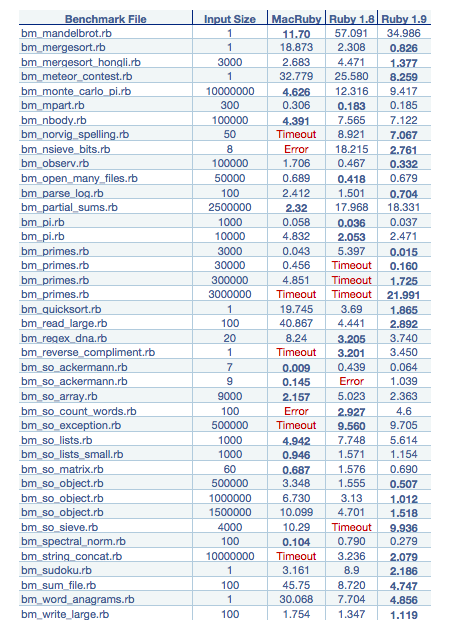
Without further hesitation, here are the execution times for the tests (divided in A-L, M-Z). Timeouts indicate that the execution of a single run took more than 60 seconds and had to be interrupted. Bold values indicate the best performance for each test.

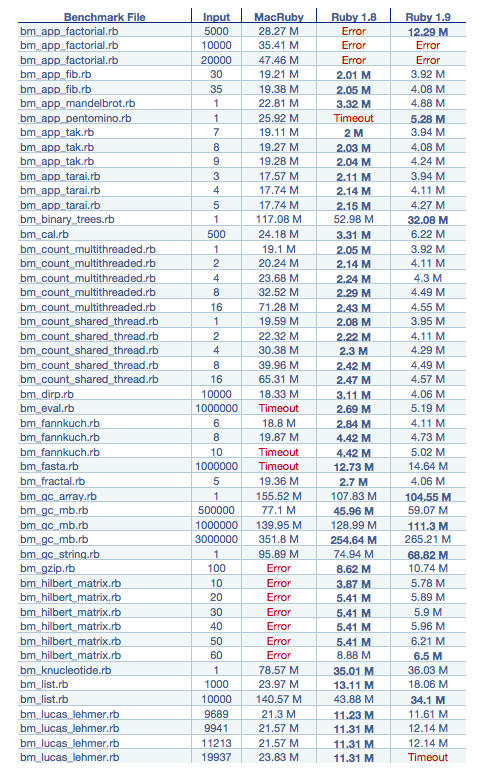
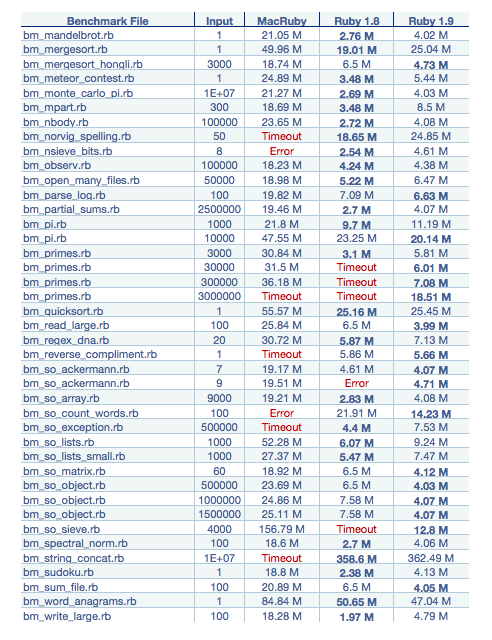
And here is the estimated memory usage:
Conclusions
MacRuby 0.6 is faster than Ruby 1.9.1 at times, but it can also be significantly slower. Overall, as things stand now, its performance appears to be between that of Ruby 1.9.1 and Ruby 1.8.7, with several outliers and a greater variance compared to those two implementations. Memory wise, MacRuby appears to be significantly more “memory hungry” than the other implementations (even though this wasn’t all that much of a surprise to me).
I’m interested in seeing how future releases that will be focused more on performance will affect these preliminary results. For the time being however, don’t let this outcome discourage you from using MacRuby 0.6, which is the first release that’s considered stable for Mac OS X development.
Download: CSV Files
PS: If you are looking for a fun and easy way to get started with MacRuby, check out ThinkCode.TV’s screencast on the subject.
Update (July 3, 2010): The following box plot compares the various implementations for the tests for which all the implementations were successful. Only times for the largest successful input number were used in those tests where multiple input numbers were tested.


Leave a Reply